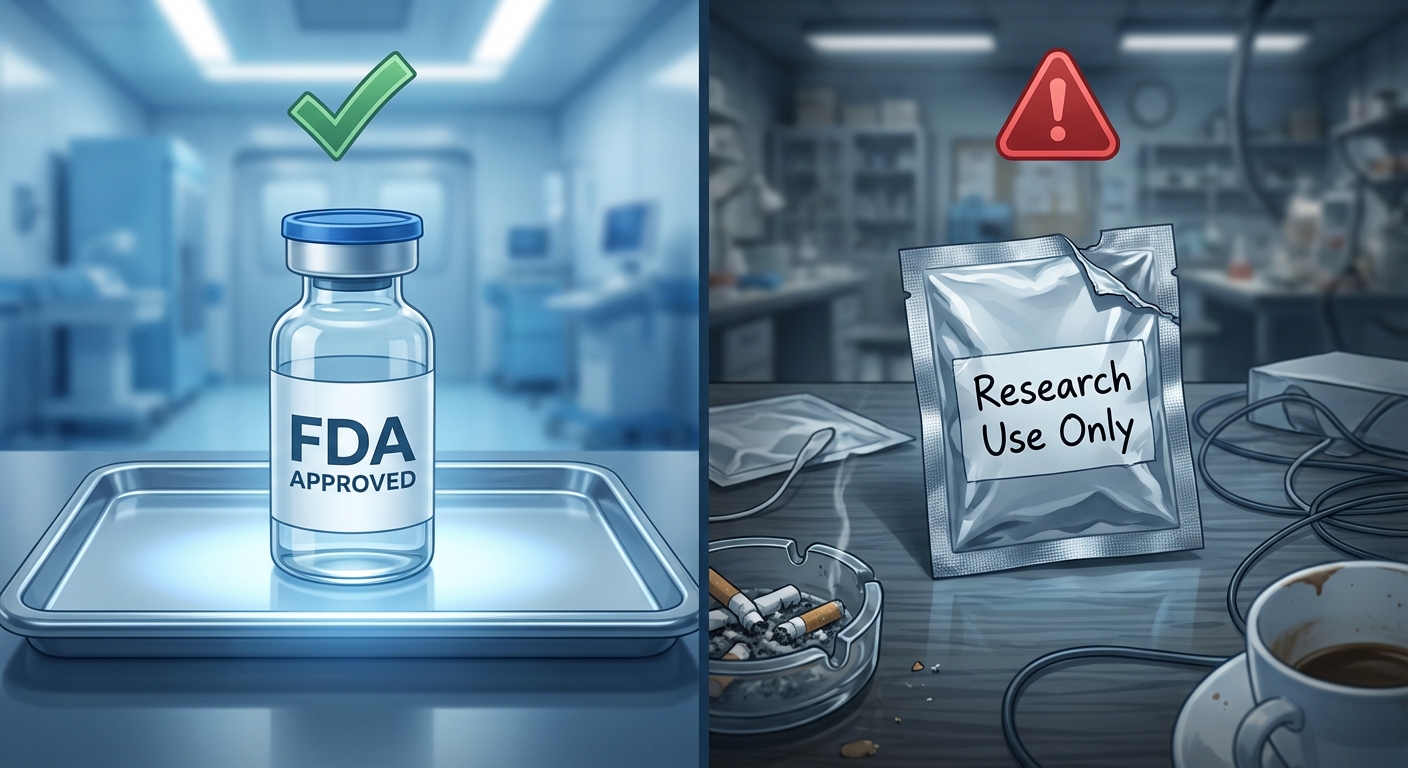
Red Flag #1: The "Research Chemical" Loophole
The single most dangerous trap for consumers is the "Research Peptide" vendor. These websites often appear in search results alongside legitimate clinics, offering vials of Semaglutide at suspiciously low prices (often under $100).
The Scam: These vendors sell lyophilized (powdered) peptides labeled explicitly as "Not for Human Consumption" or "For Research Purposes Only." By using this disclaimer, they attempt to bypass FDA regulations and medical licensing laws [cite: 1, 2].
Why It’s Dangerous
- No Sterility Testing: Legitimate injectable medications must be compounded in ISO-certified cleanrooms (USP <797> standards) to prevent bacterial and fungal contamination. Research peptides are often mixed in non-sterile labs, posing a high risk of infection [cite: 1, 3].
- Unknown Purity: Third-party testing of these products has revealed purity levels as low as 7-14%, with the remainder being unknown fillers or synthesis byproducts [cite: 4].
- Self-Mixing Risk: These products usually arrive as a powder that you must reconstitute yourself with bacteriostatic water. This "DIY" approach introduces massive room for dosing errors and contamination [cite: 5, 6].
The Bottom Line:
If a website asks you to mix your own medication or sells products labeled "Research Use Only," close the tab immediately. Legitimate medical providers will never ask a patient to act as their own pharmacist.
Red Flag #2: The "No-Questions-Asked" Prescription
Telehealth has made access to care convenient, but it has not removed the requirement for a valid physician-patient relationship. A major red flag is any platform that promises "Instant Approval" without a synchronous consultation (video/phone) or a review of recent lab work [cite: 7, 8].
The Standard of Care Checklist
Legitimate providers (like those we review on this site) adhere to strict medical standards. Before prescribing a GLP-1 agonist, a provider must evaluate:
- Kidney & Liver Function: To ensure your body can metabolize the drug safely [cite: 8, 9].
- Thyroid History: To screen for risks of Medullary Thyroid Carcinoma (MTC), a rare but serious contraindication [cite: 8].
- BMI Verification: To ensure you meet the medical criteria for treatment (typically BMI >30, or >27 with comorbidities) [cite: 10].
Warning Sign: If a site allows you to "Add to Cart" and checkout like you are buying a pair of shoes—without a medical intake form or ID verification—it is operating illegally and likely selling counterfeit products [cite: 11, 12].
Red Flag #3: The "Salt" vs. "Base" Bait-and-Switch
Not all "Semaglutide" is created equal. The FDA has issued specific warnings regarding the use of salt forms of the drug (Semaglutide Sodium or Semaglutide Acetate) versus the FDA-approved base form [cite: 13, 14].
Understanding the Chemistry
- Semaglutide Base: The active pharmaceutical ingredient (API) found in Ozempic® and Wegovy®. This is the only form that has been clinically proven safe and effective in large-scale trials [cite: 14, 15].
- Semaglutide Salts: Modified chemical structures often used for research. The FDA has stated they are "not aware of any basis for compounding using salt forms that would meet federal requirements" [cite: 13, 16].
The Risk: Salt forms may have different absorption rates and safety profiles. Some unscrupulous compounders use salts because they are cheaper to acquire from overseas chemical suppliers. A trustworthy telehealth provider will explicitly state that their pharmacy partners use Semaglutide Base [cite: 17, 18].
Red Flag #4: Cold Chain Failures (Warm Meds)
GLP-1 medications are biological peptides that are highly sensitive to temperature. They must be maintained between 36°F and 46°F (2°C to 8°C) to remain potent [cite: 19, 20].
The Logistics Test:
- Legitimate Pharmacies: Ship overnight or 2-day air in insulated coolers with ice packs or phase-change materials to ensure the product arrives cold [cite: 21, 22].
- The Red Flag: If your medication arrives in a standard bubble mailer via ground shipping (taking 5-7 days), or if the vial is hot to the touch, the peptide structure may have degraded. Degraded medication is not only ineffective but can potentially cause adverse immune reactions [cite: 21, 23].
Pro Tip: Always check the "Shipping Policy" in the FAQ section of a provider's website. If they do not guarantee cold-chain delivery, do not use them.
The "Green Light" Protocol: How to Verify Your Provider
Now that you know what to avoid, here is the forensic process for verifying a legitimate provider. We only list providers on this site that pass this rigorous 3-step audit.
Step 1: Identify the Pharmacy (503A vs. 503B)
The telehealth company (e.g., "Clinic Secret" or "OrderlyMeds") is usually just the marketing and coordination platform. The actual medication comes from a third-party pharmacy. You must identify who is filling the vial.
| Feature | 503A Pharmacy | 503B Outsourcing Facility |
|---|---|---|
| Primary Regulator | State Board of Pharmacy [cite: 24] | FDA (Direct Oversight) [cite: 25] |
| Production Scale | Patient-Specific Prescriptions | Bulk Manufacturing [cite: 26] |
| Quality Standard | USP <797> Guidelines | cGMP (Current Good Manufacturing Practice) [cite: 27] |
| Testing | Random sampling | Every batch tested for sterility/potency [cite: 26] |
The Verdict: Both are legal, but 503B facilities offer a higher tier of safety due to FDA enforcement of cGMP standards (the same standards used by Big Pharma). Top-tier telehealth providers often partner with 503B facilities to ensure consistency [cite: 28, 29].
Step 2: The "License Lookup" Hack
Don't take their word for it. Once you know the name of the pharmacy (often listed in the footer or FAQ of the telehealth site), verify their license:
- Go to the FDA’s Outsourcing Facility List to verify 503B status [cite: 30].
- For 503A pharmacies, visit the State Board of Pharmacy website for the state where the pharmacy is located (e.g., Florida, Texas, New York) [cite: 31, 32].
- Search the pharmacy name. Look for "Status: Active" and check for any "Disciplinary Actions."
Step 3: Look for LegitScript Certification
LegitScript is the industry standard for vetting online healthcare merchants. A LegitScript seal in the footer of a website means the provider has undergone a rigorous background check to verify their licensing, supply chain, and compliance with laws [cite: 11]. While not every new legitimate clinic has this yet, it is a massive trust signal.
Conclusion: Trust, But Verify
The opportunity to access GLP-1 medications at a fraction of the retail price is a game-changer for millions of Americans. However, the "Wild West" nature of the current market demands vigilance. By sticking to providers that use licensed 503A/503B pharmacies, require valid medical consultations, and guarantee cold-chain shipping, you can navigate this landscape safely.
Ready to find a vetted provider? Use our Dynamic Comparison Engine to filter clinics that have already passed this 5-step safety audit.
Sources:
- vitalityhrt.com
- charlestonhealthspan.com
- revolutionhealth.org
- nih.gov
- techtarget.com
- vitalifemd.com
- govhealthreport.com
- plushcare.com
- youtube.com
- tryeden.com
- legitscript.com
- theflowwellness.com
- healio.com
- medpagetoday.com
- hilliard-law.com
- drugs.com
- youtube.com
- serv-u-pharmacy.com
- thermalshipping.com
- thermalshipping.com
- peltonshepherd.com
- orderlymeds.com
- fda.gov
- southriverrx.com
- thefdagroup.com
- olympiapharmacy.com
- techtarget.com
- pharmaphorum.com
- fagronsterile.com
- fda.gov
- ca.gov
- virginia.gov