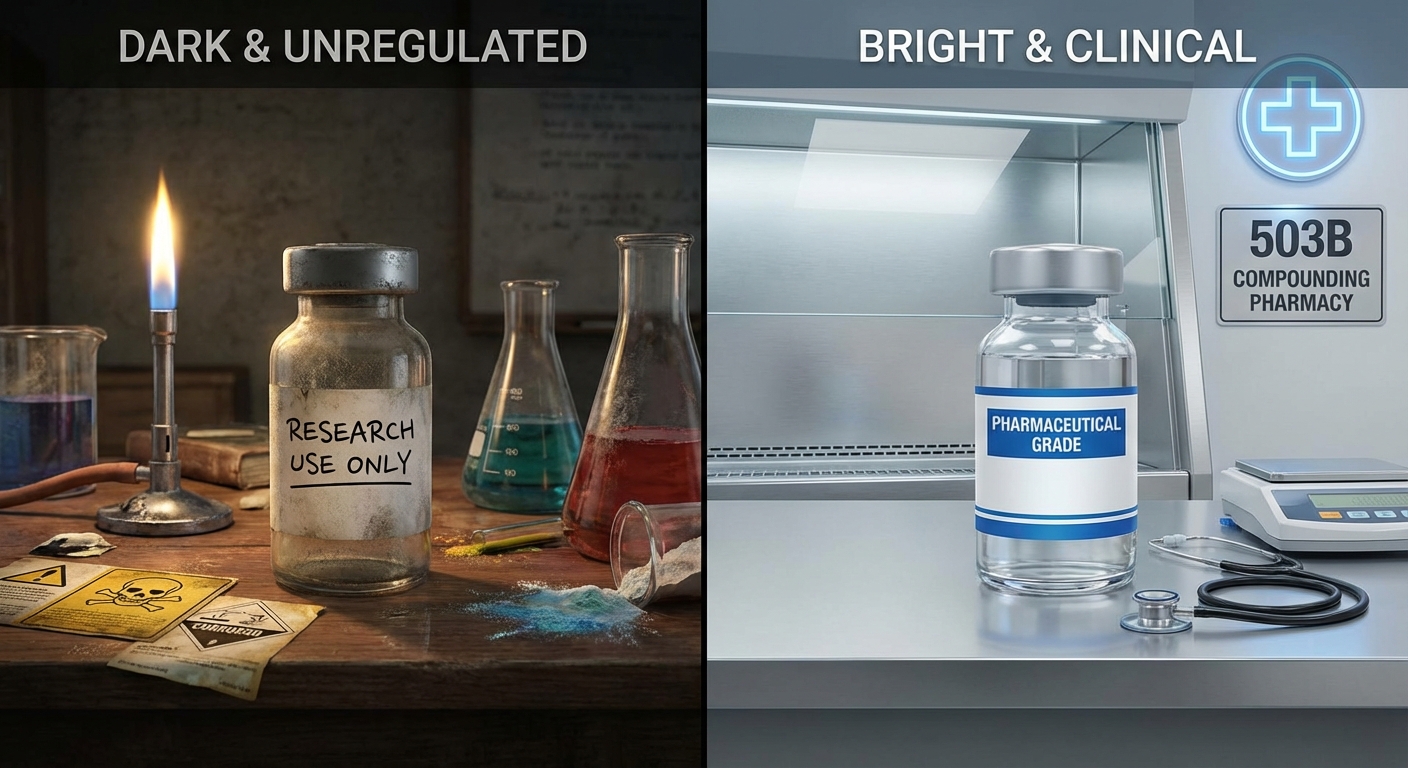
If you have been browsing Reddit forums or TikTok comments looking for a way to bypass the high cost of Zepbound® or Wegovy®, you have likely stumbled upon the "gray market" of lyophilized peptides. These are vials of powder sold online labeled "For Research Purposes Only" or "Not for Human Consumption."
The price tag is seductive—often as low as $40 or $50 per vial. For the "Priced Out" patient, this looks like a miracle. But as a forensic advocate for patient safety, I must be blunt: There is a massive, microscopic difference between the "Research Grade" peptides sold on the open web and the "Pharmaceutical Grade" medication dispensed by licensed 503A/503B pharmacies.
In this guide, we will dismantle the chemistry, the legality, and the safety risks of the DIY route. We will explain why "99% Purity" on a label doesn't mean what you think it means, and guide you toward safe, regulated telehealth options that won't compromise your biology.
The "Research Use Only" (RUO) Loophole Explained
To understand the risk, you must understand the supply chain. When you buy from a telehealth provider like OrderlyMeds or SkyRx, you are receiving medication from a licensed US compounding pharmacy. These pharmacies are regulated by State Boards of Pharmacy and, in the case of 503B facilities, the FDA directly.
"Research Chemical" vendors operate in a legal gray area. They sell raw peptide powder (lyophilized cake) often imported from overseas manufacturers. To avoid being shut down for selling unapproved drugs, they slap a disclaimer on the bottle: "Research Use Only. Not for Human Consumption."
This is not just a legal shield; it is a manufacturing reality. These products are intended for in vitro (test tube) or animal studies. They are not subjected to the rigorous purification processes required for human injectables.
The "Dirty" Truth: What's Hiding in That 99% Purity?
Many research sites boast "99% Purity" on their Certificates of Analysis (COAs). This is the most dangerous metric for a layperson because it is misleading. Purity refers to how much of the substance is the target peptide sequence (e.g., Semaglutide). It does not tell you what the remaining 1% is, nor does it account for contaminants that sit outside the peptide structure.
Here are the three hidden dangers found in Research Grade peptides that are scrubbed from Pharmaceutical Grade medications:
1. The TFA Trap (Trifluoroacetic Acid)
Peptides are synthesized using chemicals to bond amino acids together. One of the primary solvents used in this process is Trifluoroacetic Acid (TFA).
- In Pharmaceutical Grade: Manufacturers perform an expensive step called "ion exchange" to remove the TFA and replace it with a biocompatible salt (like Acetate or Chloride). This makes it safe for human injection.
- In Research Grade: To save costs, the ion exchange step is often skipped. Research peptides can contain significant residual TFA. While TFA is useful for keeping peptides stable in a lab freezer, injecting it can cause injection site reactions, tissue damage, and potential liver stress over time [cite: 1, 2].
2. Endotoxins (The Invisible Inflammation)
Endotoxins are lipopolysaccharides (LPS) found in the cell walls of bacteria. They are essentially bacterial debris left over from the manufacturing process.
- The Risk: If you inject endotoxins, your body recognizes them as a bacterial invasion. This triggers an immediate immune response. Symptoms can range from localized redness and swelling to systemic inflammation, fever, and in severe cases, septic shock [cite: 3, 4].
- The Difference: Pharmaceutical grade peptides must be "pyrogen-free" (fever-free) and pass strict USP <71> sterility and USP <85> endotoxin testing [cite: 5]. Research vendors rarely perform these expensive tests because, legally, their product is not for humans.
3. The Salt vs. Base Problem
The FDA has issued specific warnings regarding Semaglutide Sodium and Semaglutide Acetate [cite: 6, 7]. The FDA-approved active ingredient in Wegovy® and Ozempic® is the Semaglutide Base form.
Many research chemical companies sell the salt forms (Sodium/Acetate) because they are cheaper to manufacture. These salts have different absorption rates and biological activities than the base form. The FDA has explicitly stated that "products containing these salts... have not been shown to be safe and effective" [cite: 8].
Forensic Analysis: How to Spot a Fake COA
If you are still tempted by the DIY route, you must understand that the documentation provided by these sites is often forged. In our forensic review of "Research Chemical" vendors, we frequently encounter:
🚩 Red Flags of a Fake Certificate of Analysis (COA)
- Generic Lab Names: If the testing lab is "In-House" or lacks a verifiable third-party website, the results are likely biased or fabricated [cite: 9].
- Missing Batch Numbers: A COA must match the specific batch number on your vial. If the vendor uses the same COA image for six months, it is invalid [cite: 10].
- No Mass Spectrometry: HPLC tests purity, but Mass Spec confirms identity. Without Mass Spec, you could have 99% pure... baking soda [cite: 11].
- "Not for Human Use" Disclaimers: If the COA itself carries this warning, the lab is confirming they did not test for human safety parameters like sterility or endotoxins.
The 2026 Legal Crackdown: Why the "Gray Market" is Dying
As we move through 2026, the "Wild West" of research peptides is closing. Major platforms like Amazon and Alibaba have banned the sale of GLP-1 research chemicals [cite: 12, 13]. Furthermore, the FDA and state boards are aggressively targeting vendors who imply their research chemicals can be used for weight loss.
The Financial Risk: We are seeing an increase in reports of seized packages and "exit scams," where gray market vendors disappear with customer money. Because the transaction was for a "research chemical" technically not allowed for human use, you have zero recourse with your credit card company or the law.
The Safe Alternative: The "Flight" Path
You do not have to choose between $1,200 retail prices and dangerous $50 research powders. The legitimate "Flight" path—Telehealth with Compounded Medication—offers the safety of pharmaceutical-grade regulation at a fraction of the retail cost.
When you use a vetted telehealth provider, you are paying for:
- Doctor Oversight: A licensed physician reviews your medical history to ensure you are a candidate.
- 503A/503B Pharmacy Sourcing: The medication is made in US-based, regulated facilities that must perform sterility and endotoxin testing [cite: 5].
- Cold Chain Shipping: Ensuring the peptide doesn't degrade in heat (a common issue with gray market shipping).
- Legal Recourse: You are a patient, not a "researcher," with rights and protections.
Comparison: Research vs. Telehealth
| Feature | Research Grade (DIY) | Telehealth (Compounded) |
|---|---|---|
| Intended Use | Lab Animals / Test Tubes | Human Injection |
| TFA Removal | Rare (High Risk) | Mandatory |
| Endotoxin Testing | No | Yes (USP Standards) |
| FDA Oversight | None (Loophole) | State Board / FDA (503B) |
| Cost | $50 - $100 / month | $250 - $400 / month |
Conclusion: Don't Gamble with Your Biology
The allure of saving money is powerful, especially when insurance denies your claim. But injecting a substance labeled "Not for Human Consumption" is a gamble with your liver, your immune system, and your long-term health.
Your Roadmap to Safe Access:
- Step 1: Try to get coverage first. Use our Free Insurance Appeal Generator to fight your denial.
- Step 2: If coverage fails, choose a vetted provider. Use our Telehealth Comparison Tool to find providers like OrderlyMeds or SkyRx that use FDA-regulated pharmacies, offering you safety for roughly $10 a day.
Disclaimer: This article is for informational purposes only and does not constitute medical advice. We do not endorse the purchase or use of research chemicals for human consumption. Always consult with a licensed healthcare provider before starting any weight loss medication.