You’ve done the research. You’ve navigated the telehealth maze. You’ve finally received your vial of compounded Semaglutide. You take your first injection, expecting the weight to melt off overnight.
One week later, the scale hasn't budged.
Panic sets in. Did I get a bad batch? Is this a scam? Am I a non-responder?
Before you spiral, you need to understand the pharmacokinetics of GLP-1 agonists. Unlike stimulants that work immediately, Semaglutide builds up in your system over time. This guide serves as your forensic timeline, breaking down exactly what to expect week-by-week, based on clinical data and real-world patient outcomes. We will demystify the "Loading Phase," identify when the "Therapeutic Dose" kicks in, and help you benchmark your progress against the averages.
The Science of "Steady State": Why The First Month is Slow
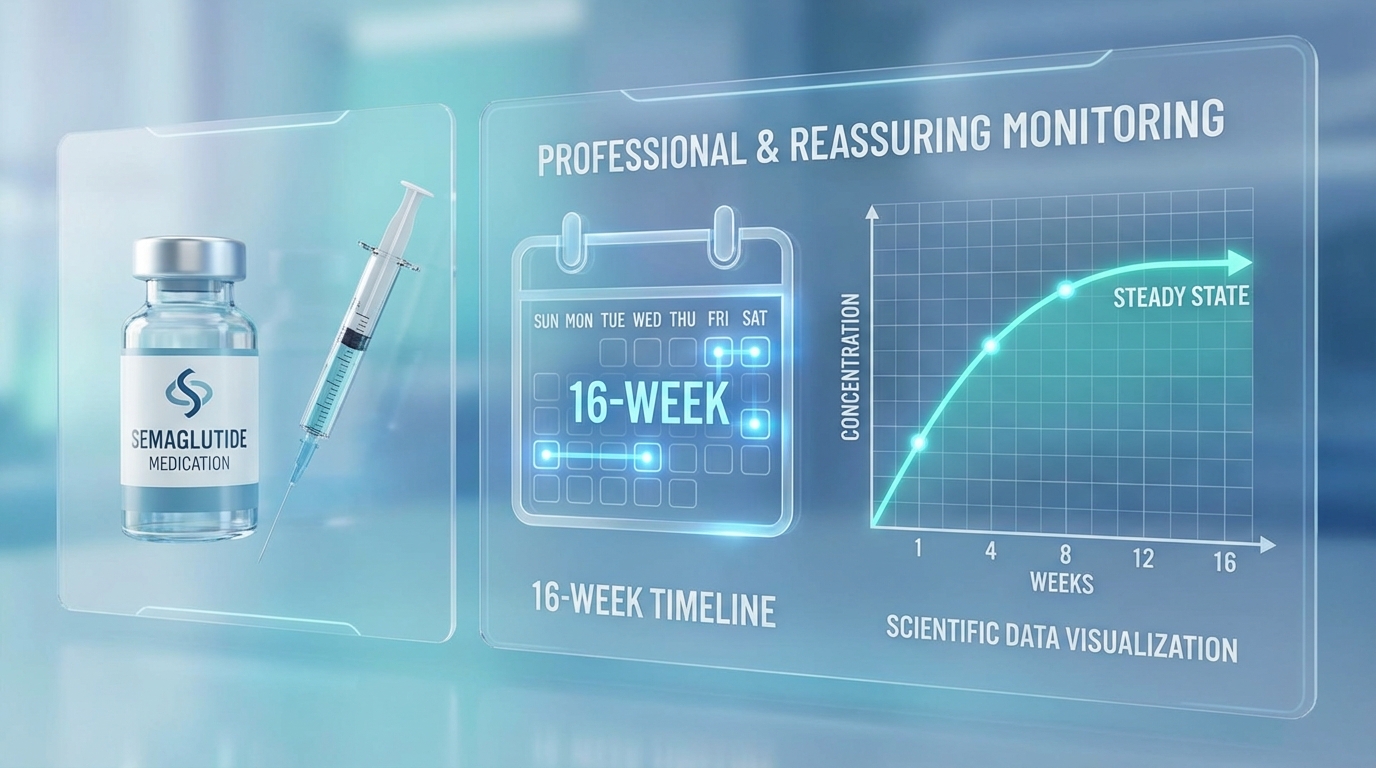
To understand the timeline, you must understand the concept of half-life. Semaglutide has a half-life of approximately 7 days [cite: 1]. This means that seven days after your shot, half of the medication is still in your system.
When you take your second shot, you are adding a new dose on top of the remaining half of the previous dose. It takes about 4 to 5 weeks of consistent weekly dosing to reach what is called a "steady state"—where the concentration of the drug in your body remains consistent and effective [cite: 2, 3].
Key Takeaway: The first month is not about weight loss; it is about preparing your body to tolerate the medication without severe gastrointestinal distress.
Phase 1: The Loading Phase (Weeks 1 – 8)
Goal: Acclimation & Safety
Typical Dosage: 0.25 mg to 0.5 mg
Weeks 1-4: The "Introduction" (0.25 mg)
Your provider will almost always start you at 0.25 mg (or 10 units, depending on your vial's concentration).
- What to Expect: You likely won't feel much. Some patients report a "placebo effect" of reduced hunger, but physiologically, this dose is too low for significant weight loss in most people [cite: 4, 5].
- Weight Loss Benchmark: 0 - 4 lbs (mostly water weight).
- Side Effect Watch: Mild nausea, slight fatigue, or constipation. If you feel nothing, that is good. It means your body is tolerating the peptide [cite: 6, 7].
- Forensic Note: Do not increase your dose early. Rushing this phase is the #1 cause of severe vomiting and ER visits.
Weeks 5-8: The "Step Up" (0.5 mg)
If you tolerated the first month well, your telehealth provider (e.g., SkyRx, OrderlyMeds) will advise you to double the dose to 0.5 mg.
- What to Expect: This is where the "food noise" begins to quiet down. You might notice you leave half a sandwich on your plate or forget to snack in the afternoon [cite: 8, 9].
- Weight Loss Benchmark: 4 - 8 lbs total (cumulative).
- The "Reality Check": If you still haven't lost weight by week 8, don't panic. You are still below the clinical therapeutic dose.
Phase 2: The Therapeutic Transition (Weeks 9 – 16)
Goal: Consistent Fat Loss
Typical Dosage: 1.0 mg to 1.7 mg
This is the "Sweet Spot." You are now approaching the doses used in the major clinical trials (STEP 1) that showed significant results [cite: 10, 11].
Weeks 9-12: The "Therapeutic Threshold" (1.0 mg)
At 1.0 mg, the medication is firing on all cylinders. Gastric emptying is significantly slowed, and blood sugar regulation is optimized.
- What to Expect: Appetite suppression should be distinct. Cravings for sugar and alcohol often disappear.
- Weight Loss Benchmark: 1 - 2 lbs per week consistently [cite: 12, 13].
- Forensic Warning: This is often where side effects peak. Ensure you are prioritizing protein and hydration (electrolytes are key).
Weeks 13-16: The "Accelerator" (1.7 mg)
Many patients stay at 1.0 mg if they are losing weight. However, if your loss has stalled (a plateau), your provider may move you to 1.7 mg.
- What to Expect: Deep appetite suppression. You may need to schedule meals to ensure you are eating enough calories to prevent muscle loss.
- Weight Loss Benchmark: Total loss of 10-15% of body weight is common by this stage for high responders [cite: 14, 15].
Phase 3: Maintenance & Optimization (Week 17+)
Goal: Long-Term Management
Typical Dosage: 2.4 mg (Max Dose)
Week 17 Onwards: The "Full Dose" (2.4 mg)
2.4 mg is the target dose for the brand-name Wegovy® trials [cite: 5, 16]. However, in the compounded telehealth world, many patients never need to go this high.
- The Plateau Phenomenon: It is normal for weight loss to slow down after 6 months. Your body fights to maintain homeostasis (its "set point") [cite: 17, 18].
- Breaking a Plateau:
- Titrate Up: If you are not at 2.4 mg yet, increase the dose.
- Switch Medications: This is often when patients switch to Tirzepatide, which targets both GLP-1 and GIP receptors for a stronger metabolic effect [cite: 19, 20].
Semaglutide vs. Tirzepatide: Speed Comparison
If speed is your priority, the data suggests Tirzepatide (the active ingredient in Mounjaro/Zepbound) is faster and more potent.
| Feature | Semaglutide (GLP-1) | Tirzepatide (GLP-1 + GIP) |
|---|---|---|
| Mechanism | Single Agonist (Appetite) | Dual Agonist (Appetite + Metabolic) |
| Avg. Weight Loss (68-72 Weeks) | ~15% [cite: 10, 11] | ~20-22% [cite: 20, 21] |
| Onset of Action | Slower (Weeks 8-12) | Faster (Weeks 4-8) [cite: 22] |
| Cost (Compounded) | Lower (~$200-$300/mo) | Higher (~$350-$500/mo) |
Verdict: If you have a higher BMI (>35) or have stalled on Semaglutide, Tirzepatide is the clinically superior choice for breaking through resistance [cite: 23, 24].
Troubleshooting: "I'm Not Losing Weight"
If you are at Week 12 and have lost zero weight, investigate these three factors:
- The "Bunk" Factor: Are you buying from a "research chemical" site or a legitimate telehealth clinic? Research peptides often have low purity. Stick to providers like OrderlyMeds or Mochi Health that use regulated 503A/503B pharmacies [cite: 25, 26].
- The "Under-Dose": Some med-spas dilute their vials to save money. Check your prescription. Are you actually getting 1.0 mg, or just 0.25 mg disguised as a "high volume" shot?
- The "Non-Responder": Approximately 10-15% of the population does not respond to GLP-1s alone. These patients often require Tirzepatide or Retatrutide (upcoming) [cite: 16].
Final Verdict: Trust the Process (and the Provider)
The Semaglutide timeline is a marathon, not a sprint. The "magic" isn't in the first shot—it's in the consistency of weeks 12 through 68.
Your Action Plan:
- Commit to 3 Months: Do not judge the medication before Week 12.
- Track Your Macros: The drug reduces appetite, but you must eat protein to lose fat instead of muscle.
- Verify Your Source: Ensure your compounded Semaglutide comes from a licensed US pharmacy to guarantee potency.
Disclaimer: This article is for educational purposes only and does not constitute medical advice. Always consult with a licensed healthcare provider before starting any weight loss medication.