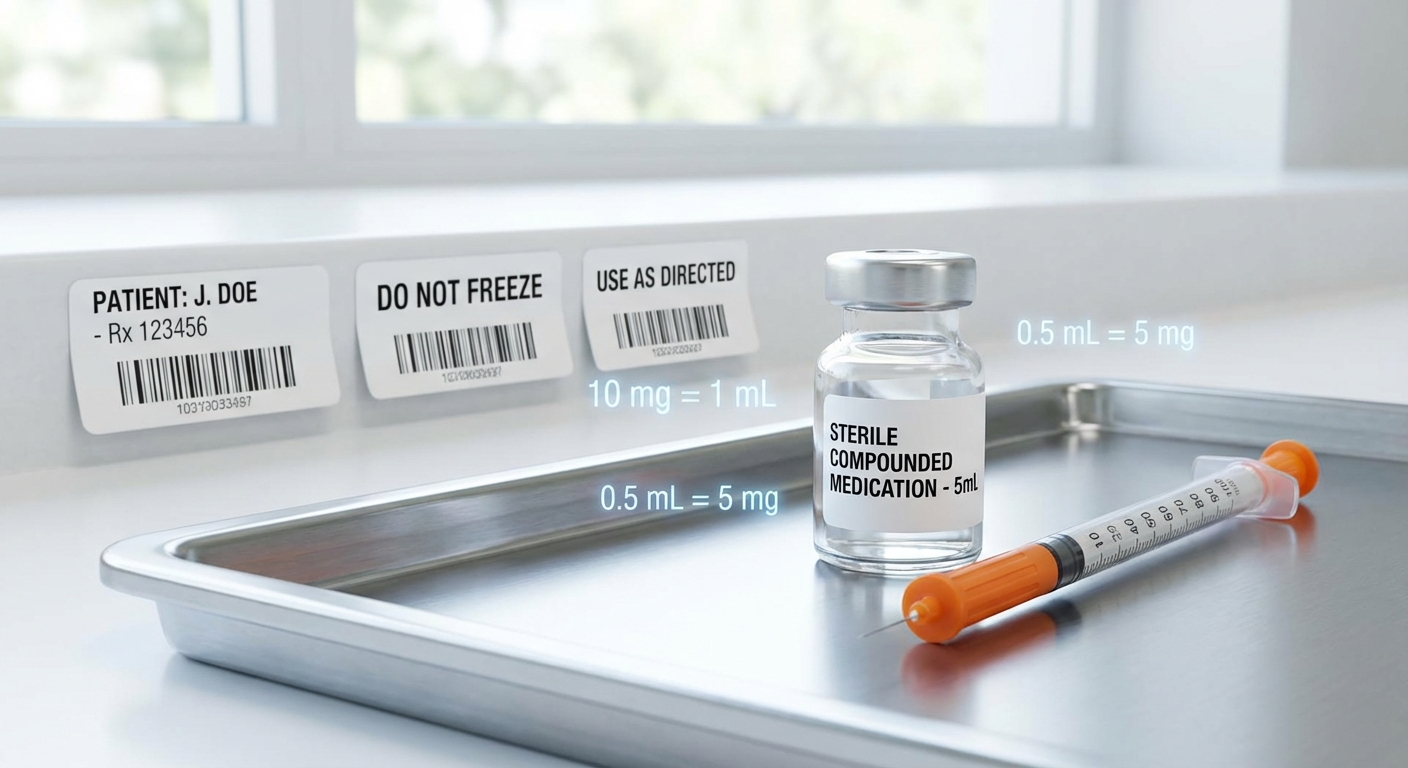
You just received your first shipment of compounded Semaglutide or Tirzepatide. You open the box, expecting the familiar "click" pen you saw in the commercials. Instead, you find a glass vial and a bag of insulin syringes. The prescription label says "Inject 50 Units," but your doctor said you were on "2.5 milligrams." Panic sets in. Did they send the wrong thing? Are you about to take a massive overdose?
Welcome to the "Units Trap." It is the single most common source of anxiety for patients switching from name-brand drugs like Wegovy® or Zepbound® to telehealth alternatives.
Here is the hard truth: "Units" are a measure of volume, not medicine. 50 units in a vial from Hallandale Pharmacy is a completely different dose than 50 units from Empower Pharmacy. If you treat them the same, you risk severe side effects or zero results.
This forensic guide will strip away the confusion. We will break down the math, compare the specific concentrations used by the top FDA-regulated 503A pharmacies, and give you the tools to inject with absolute confidence.
The Golden Rule: Concentration is King
To survive the switch to compounded GLP-1s, you must understand one concept: Concentration.
Think of it like making coffee. You can have a tiny shot of espresso (high concentration) or a giant mug of weak drip coffee (low concentration). Both might contain the same amount of caffeine (the "drug"), but the volume of liquid you drink is very different.
- Milligrams (mg): The actual amount of medication. (e.g., "I need 2.5mg of Tirzepatide").
- Milliliters (mL): The amount of liquid in the syringe.
- Units: The markings on the syringe. On a standard U-100 insulin syringe, 100 Units = 1 mL.
The "Trap" happens when patients compare "Units" with their friends online. "My friend takes 20 units, so I should too." Wrong. If your friend's vial is twice as concentrated as yours, you just took half the dose you needed.
Forensic Analysis: Pharmacy Concentration Cheat Sheet
We have analyzed the standard compounding formulations from the major pharmacies used by top telehealth providers (like OrderlyMeds, Emerge, and Lavender Sky).
*Note: Pharmacies can change concentrations at any time. ALWAYS read your specific vial label. The data below represents standard formulations as of late 2024/early 2025.*
1. Hallandale Pharmacy (The "Standard" Standard)
Hallandale is one of the largest 503A pharmacies supplying many telehealth platforms. They are known for consistency, but they change concentrations as you move up in dosage to keep the injection volume small.
| Medication | Common Concentration | The Math (Example) |
|---|---|---|
| Semaglutide (Low Dose) | 2.5 mg/mL | To get 0.25mg, you inject 10 Units. |
| Semaglutide (High Dose) | 5.0 mg/mL | To get 2.4mg, you inject 48 Units. |
| Tirzepatide (All Doses) | 10 mg/mL (Standard) | To get 5.0mg, you inject 50 Units. |
The Hallandale Quirk: Notice that for Tirzepatide, they often use a 10mg/mL concentration [1]. This makes the math easy: 2.5mg = 25 units, 5mg = 50 units, 7.5mg = 75 units. However, for higher doses (like 15mg), this would require two injections (150 units), so they may switch you to a 20mg/mL vial [2]. If you don't notice the switch, you could accidentally double your dose.
2. Empower Pharmacy (The "Pink" Mix)
Empower Pharmacy is a 503A/503B giant. Their formulations are distinct because they often compound with Niacinamide (Vitamin B3) or Cyanocobalamin (B12), giving the liquid a pink or red tint [3, 4].
- Tirzepatide/Niacinamide: Often comes in 8 mg/mL or 17 mg/mL vials [5].
- The Math Trap: 8 mg/mL is a "weird" number.
To get a 2.5mg dose from an 8mg/mL vial, you need 31 Units (approx).
To get a 5.0mg dose from a 17mg/mL vial, you need 29 Units (approx).
Warning: Unlike Hallandale's "easy math," Empower's concentrations require you to strictly follow the chart provided by your provider. Do not guess.
3. Red Rock Pharmacy (The "Variable" Vials)
Red Rock is unique because they compound specific vials for specific dosages to prevent waste. This means they have many different concentrations [6, 7].
- Low Dose Vial: Might be 8.5 mg/mL.
- High Dose Vial: Might be 20 mg/mL.
- The Risk: If you have leftover medication from a "Month 1" vial and try to combine it with a "Month 2" vial, you are mixing two different potencies. Never mix vials from Red Rock.
How to Calculate Your Dose (The "Life-Raft" Formula)
Lost your instruction card? Provider support taking too long to reply? You can calculate your dose yourself if you have the vial in front of you.
The Universal Dosing Formula
(Target Dose in mg) ÷ (Vial Concentration in mg/mL) = Volume in mL
Then, multiply by 100 to get "Units."
Real-World Example:
You are prescribed 5mg of Tirzepatide.
Your vial says "Tirzepatide 10mg/mL".
- Step 1: 5 (Target) ÷ 10 (Concentration) = 0.5 mL.
- Step 2: 0.5 mL × 100 = 50 Units.
Result: Draw to the "50" line on your insulin syringe.
Reading the Syringe: Don't Miss the Lines
Most telehealth providers send U-100 Insulin Syringes [8, 9]. These are the industry standard, but they can be tricky to read.
- The Big Numbers (10, 20, 30...): These represent 10 units.
- The Medium Lines: Usually represent 5 units (15, 25, 35...).
- The Tiny Lines: On a standard 1mL syringe, each tiny tick mark represents 2 Units [10]. On a smaller 0.5mL or 0.3mL syringe, each tick might represent 1 Unit.
CRITICAL SAFETY CHECK: Look at your syringe before you draw. If there are 5 tick marks between "10" and "20," each tick is 2 units. If there are 10 tick marks, each tick is 1 unit. Misreading this is the difference between a 2.5mg dose and a 3.0mg dose.
Red Flags: When to NOT Inject
In our forensic reviews of providers, we sometimes see pharmacies that don't meet our safety standards. If your vial looks like this, pause and contact your provider immediately.
1. "Semaglutide Sodium" or "Acetate"
Check the ingredient label. It should say "Semaglutide" or "Semaglutide Base." If it says "Sodium" or "Acetate," this is a salt form of the drug that the FDA has explicitly warned against [11]. It is not the same biologic grade as the commercial drug.
2. Cloudy or Particulate Matter
Semaglutide and Tirzepatide should be clear. [3, 4].
If it is pink/red, that is likely B12 (safe, if prescribed).
If it is cloudy, milky, or has floating specks, the peptide has degraded or is contaminated. Do not inject.
3. The "Research Only" Vial
If you bought a vial of powder that says "Not for Human Consumption" and you are reconstituting it yourself with bacteriostatic water, you have left the medical system entirely. This guide applies to prescription compounded medications from licensed pharmacies. "Research peptides" have zero quality control guarantees.
Summary: The "Flight" Path to Safety
Switching to compounded telehealth is a smart financial move for the "Priced Out" patient, saving you over $10,000 a year. But it requires you to take ownership of your medical administration.
Your Checklist Before Every Injection:
- Read the Vial Concentration: Did it change from last month?
- Calculate the Volume: Dose ÷ Concentration.
- Check the Syringe Scale: Is one tick mark 1 unit or 2 units?
- Inspect the Liquid: Clear? No floaters?
If this math feels overwhelming, or if you are worried about making a mistake, you might be better suited for a provider that offers pre-filled syringes or oral alternatives (though oral efficacy is debated).
Still fighting for brand-name coverage? Don't give up yet. Use our Free AI Appeal Generator to fight your insurance denial before you switch to cash-pay compounds.