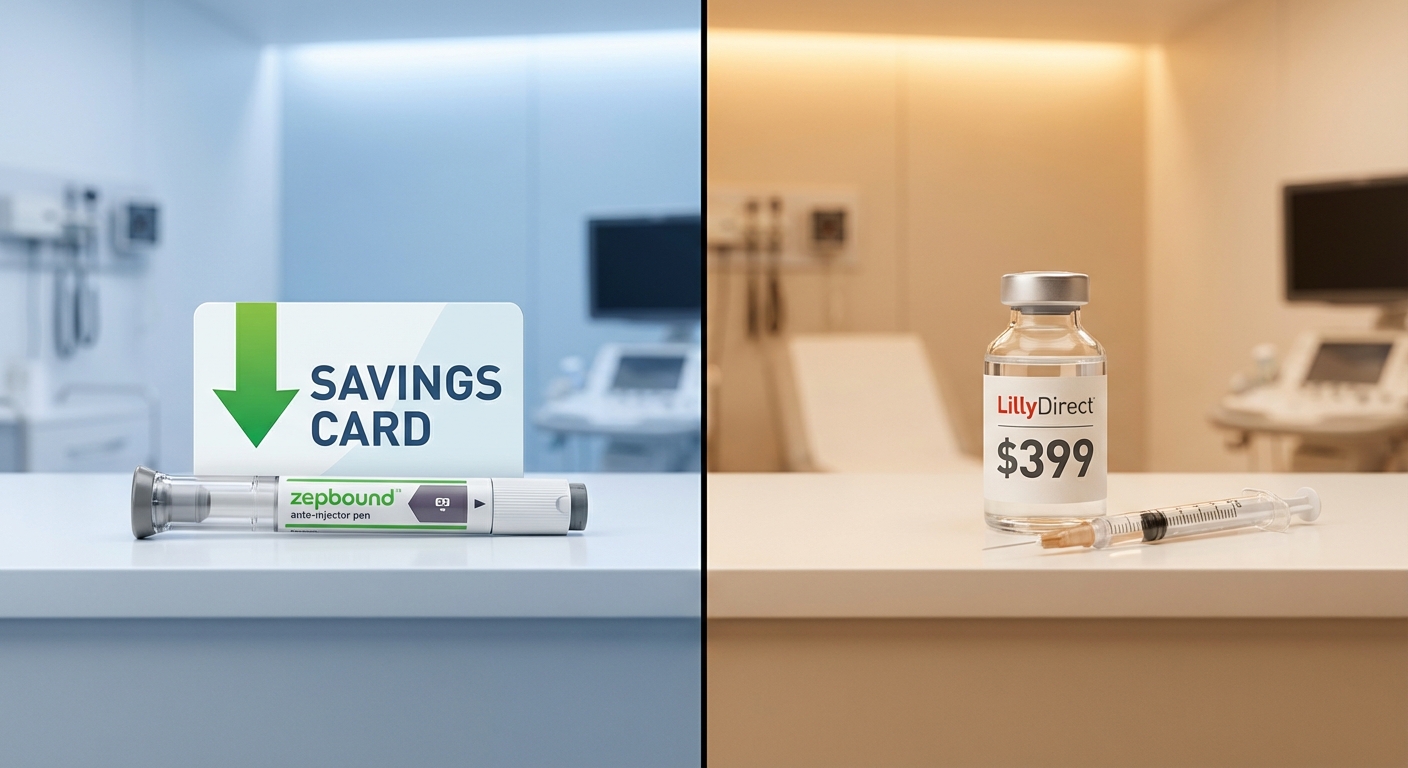
For the past two years, the GLP-1 landscape has been defined by two extremes: the lucky few with $25 insurance copays, and the "Priced Out" majority relying on compounded alternatives. But as we enter 2026, the middle ground has shifted. Eli Lilly has introduced a new "Cash-Pay" vial strategy while simultaneously tightening the terms of their famous Savings Card. If you are navigating a denial or paying out of pocket, the math just changed.
The 2026 Zepbound Savings Card: What Changed?
If you rely on the Zepbound Savings Card to make your medication affordable, you need to check your pharmacy receipts immediately. While the headline "Pay as little as $25" remains, the fine print for 2026 has introduced stricter caps that could leave you with a surprise bill later in the year.
⚠️ The "Hidden" Cap Reduction
For patients with commercial insurance that covers Zepbound, the Annual Savings Cap has been reduced from $1,950 (in 2025) to $1,300 (in 2026) [cite: 1, 2].
This reduction is significant. If your insurance copay is high (e.g., a high-deductible plan where you pay $200+ per month), you will burn through that $1,300 cap much faster than before. Once the cap is reached, you are responsible for the full copay amount for the remainder of the year.
The New 2026 Terms at a Glance
| Feature | 2025 Terms | 2026 Terms | Impact |
|---|---|---|---|
| Monthly Savings Cap (Insured) | $150 off copay | $100 off copay | You pay $50 more/mo |
| Annual Savings Cap (Insured) | $1,950 | $1,300 | Benefits end sooner |
| Price for Uninsured (Commercial) | ~$550 / month | ~$499 / month | Slight improvement |
| Expiration | 12/31/2025 | 12/31/2026 | Extended |
The Takeaway: Eli Lilly is tightening the faucet. If you have coverage, your out-of-pocket costs are likely rising. If you don't have coverage, the savings card price of ~$499 for the auto-injector pens is still steep compared to the compounded market. However, there is a new player on the board that changes the equation entirely: LillyDirect Vials.
The "Middle Path": LillyDirect Single-Dose Vials
In a strategic move to undercut the compounding market, Eli Lilly has released Zepbound in single-dose vials available exclusively through their direct-to-consumer platform, LillyDirect [cite: 3, 4]. These vials bypass the traditional pharmacy benefit manager (PBM) rebate system and are priced for "Cash Pay" patients.
Crucially, you do not use the Savings Card for these vials. The price is flat, transparent, and significantly lower than the retail price of the pens.
2026 Vial Pricing (Cash Pay)
- 2.5 mg (Starter): $299 / month [cite: 3]
- 5 mg: $399 / month [cite: 3]
- 7.5 mg - 15 mg: $449 / month [cite: 3, 4]
This pricing structure creates a fascinating "Economic Arbitrage" opportunity. For patients on 5mg or higher, the price gap between Compounded Tirzepatide (typically $300-$400/month at reputable providers like OrderlyMeds or Mochi) and Brand Name Vials ($399-$449) has narrowed to less than $100.
Forensic Comparison: Compounded vs. Brand Vials
For the "Priced Out" persona, the decision used to be easy: $1,200 for brand vs. $300 for compound. Now, the choice is $449 for brand vs. $300 for compound. Is the extra $150 worth it? Let's look at the data.
Option A: Compounded Tirzepatide
- ✔ Price: $299 - $399/mo (Flat rate often available).
- ✔ Availability: Generally consistent, though dependent on FDA shortage status.
- ✔ Additives: Often includes B12 or Glycine for side effect mitigation.
- ✘ Regulatory Risk: Subject to the "FDA Cliff" (see below).
Option B: LillyDirect Vials
- ✔ Price: $399 - $449/mo (Cash Pay).
- ✔ Certainty: 100% FDA-approved product. No variation in potency.
- ✔ Future Proof: Immune to compounding regulatory crackdowns.
- ✘ Equipment: Requires learning to use a syringe (not an auto-injector).
The "FDA Cliff": Why 2026 is the Turning Point
The most critical factor in your decision isn't just price—it's legality. The FDA officially declared the shortage of Tirzepatide resolved in late 2024, and Semaglutide followed in February 2025 [cite: 5, 6, 7].
Under the Federal Food, Drug, and Cosmetic Act, compounding pharmacies (503A and 503B) are generally prohibited from making "essential copies" of commercially available drugs unless they are on the FDA shortage list [cite: 8, 9].
The Grace Period Countdown
While legal battles from the Outsourcing Facilities Association (OFA) have slowed the crackdown, the FDA has established strict "off-ramps" for compounders:
- 503A Pharmacies (Patient Specific): Typically given 60 days post-shortage resolution to cease compounding "copies" [cite: 10, 11].
- 503B Facilities (Outsourcing): Typically given 90 days [cite: 10].
What this means for you: If you are using a telehealth provider that relies solely on the "shortage loophole," your supply could be cut off or forced to change formulations (e.g., adding B12 or changing dosage strength) to avoid being classified as a "copy" [cite: 12, 13].
Strategic Recommendation: Which Path Should You Take?
Path 1: The "Safety First" Switch
If you are currently paying $350+ for compounded Tirzepatide, we strongly recommend considering the switch to LillyDirect Vials ($399-$449).
Why? For a difference of ~$50-$100/month, you gain total immunity from the regulatory volatility of the compounding market. You also eliminate any "batch anxiety" regarding potency or sterility. The learning curve of using a syringe is minimal (we have guides on this), and the peace of mind is significant.
Path 2: The "Budget Optimizer" Holdout
If you are on a lower dose (e.g., Semaglutide or low-dose Tirzepatide) and paying under $300/month, sticking with a reputable compounded provider (like OrderlyMeds or Mochi) still makes financial sense—for now.
Why? The price gap is still large enough to justify the "Flight" path. However, you must ensure your provider is transparent about their 503A/503B pharmacy partners and has a plan for the post-shortage regulatory environment (e.g., personalized dosages).
Path 3: The "Denied Fighter"
If you have commercial insurance but were denied, do not jump straight to cash pay. Use our Appeal Generator first.
Why? Even with the reduced 2026 Savings Card caps, paying $25/month (or even $100/month after the cap reduction) is vastly superior to paying $399/month. Fight the denial first; use the vials as your backup plan.
Don't Let Insurance Win.
Before you pay $399 for a vial, generate a professional appeal letter in 2 minutes. Our AI analyzes your specific denial reason to build the strongest case for coverage.
Generate Free Appeal Letter